Home / Guides / Claude Code vs Cursor
Claude Code vs Cursor Rate Limits: Full Comparison
Both Claude Code and Cursor enforce rate limits, but they work very differently. Here is a side-by-side breakdown of how each tool caps usage, what it costs, and what happens when you hit the wall.
Last updated March 2026 · By Soren Starck
Quick Comparison
| Claude Code | Cursor | |
|---|---|---|
| Limit type | Rolling 5-hour token window | Monthly request count (fast/slow) |
| Reset | Continuous (oldest tokens roll off after 5h) | Monthly billing cycle |
| Warning | “90% of session limit” | Usage bar in settings |
| When limited | Requests rejected until window rolls | Switches to slow model |
| Entry price | $20/mo (Pro) | $20/mo (Pro) |
| Power tier | $100-$200/mo (Max 5x/20x) | $40/mo (Business) |
How Claude Code Rate Limits Work
Claude Code enforces a rolling 5-hour window based on token consumption. Every prompt you send and every response you receive counts as tokens. The tokens you used 5 hours ago gradually free up.
This means Claude Code limits are session-based. If you have a heavy morning session, you might get locked out by lunch. But by mid-afternoon, your morning tokens are rolling off and you can work again.
The downside: you get very little visibility into your current usage. Claude only warns you at 90%, which is often too late to adjust.
For a deep dive, see our complete guide to Claude Code rate limits.
How Cursor Rate Limits Work
Cursor uses a monthly request-based system. On the Pro plan ($20/mo), you get a set number of “fast” requests per month. When you exhaust them, Cursor switches to a slower model instead of locking you out entirely.
This is fundamentally different from Claude Code. With Cursor, you can always keep working (just slower). With Claude Code, you are locked out completely until the window rolls.
Which Limits Feel Worse?
Claude Code limits are more disruptive. When you hit the wall, you lose all access to the tool. There is no fallback. You are either within the limit or locked out.
Cursor's approach is more graceful: it degrades to a slower model rather than cutting you off. But the slower model is noticeably less capable, which can be frustrating for complex tasks.
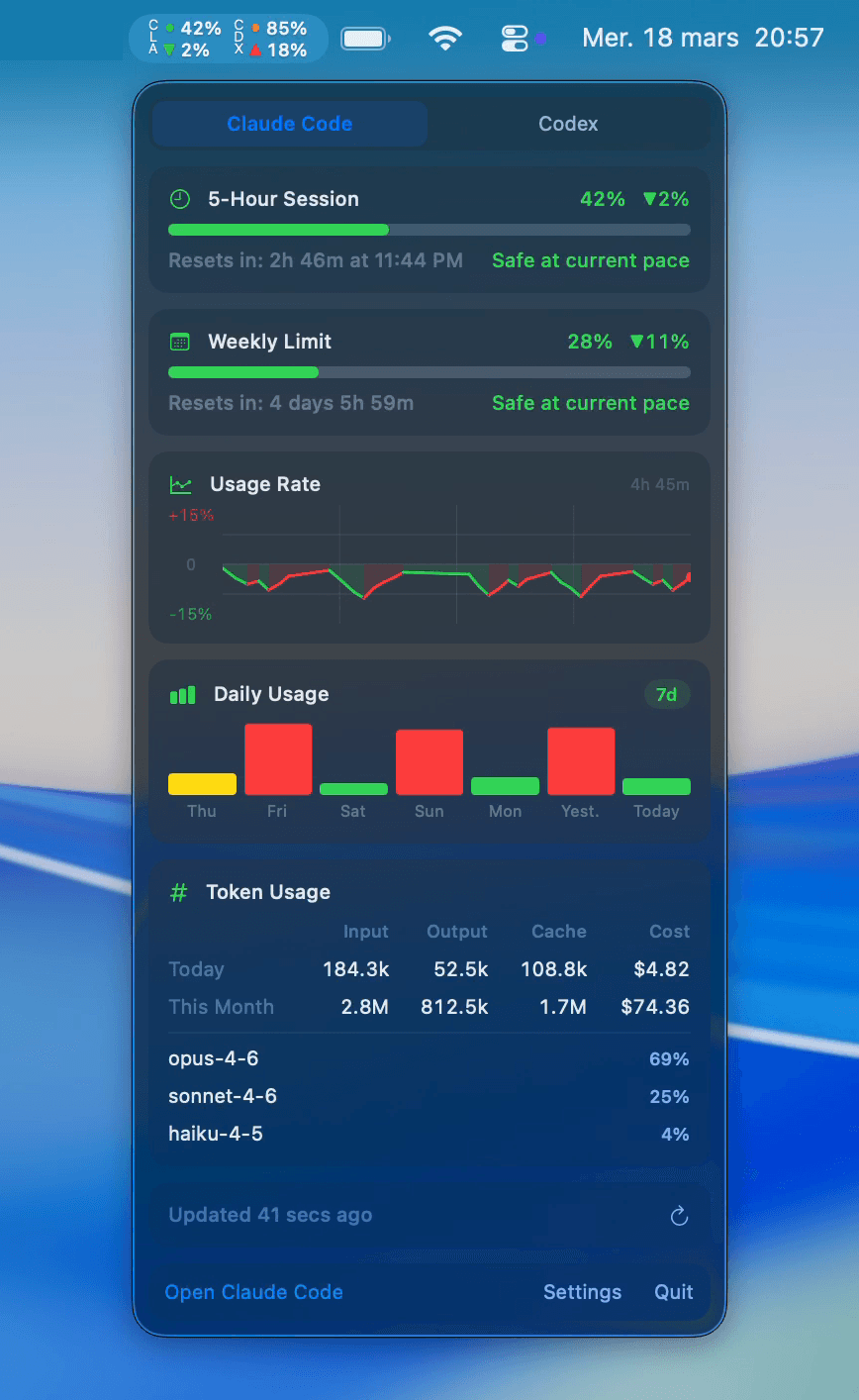
The real difference is predictability. Cursor shows you a clear count of remaining fast requests. Claude Code gives you almost no visibility until you are about to hit the limit. This is the exact gap that SessionWatcher fills -- it adds the same always-visible usage tracking that Cursor has built-in.
 SessionWatcher
Cursor shows your usage.
Claude Code doesn't. Fix that.
Native macOS menu bar app. Track Claude and Codex usage, costs, and rate limits in real-time.

“Fast, simple, and does exactly what it should. Definitely worth it.”
@nicojerome on GitHub
macOS 14+. $2.99 one-time purchase.
Pricing Breakdown
| Plan | Price | What You Get |
|---|---|---|
| Claude Code | ||
| Pro | $20/mo | Standard token limits, 5-hour rolling window |
| Max 5x | $100/mo | 5x token capacity |
| Max 20x | $200/mo | 20x token capacity |
| Cursor | ||
| Hobby | Free | Limited requests, slow model |
| Pro | $20/mo | 500 fast requests/mo, unlimited slow |
| Business | $40/user/mo | More fast requests, admin controls |
Can You Use Both?
Yes, and many developers do. Claude Code and Cursor have completely independent rate limits. Using one does not affect the other. A common workflow:
- Cursor for in-editor autocomplete and inline edits
- Claude Code for terminal-based tasks, file creation, and complex multi-file changes
This effectively doubles your AI coding capacity since you are drawing from two separate pools.
Which Is Better for Heavy Users?
It depends on your workflow:
- Terminal-first developers: Claude Code Max ($100-200/mo) gives you the most raw capacity for CLI-based workflows
- Editor-first developers: Cursor Pro ($20/mo) with its graceful degradation may cause less disruption
- Maximum throughput: Use both tools to double your effective capacity
SessionWatcherUsing both tools?
Track both rate limits in one app.
Native macOS menu bar app. Track Claude and Codex usage, costs, and rate limits in real-time.
“Fast, simple, and does exactly what it should. Definitely worth it.”
@nicojerome on GitHub
macOS 14+. $7.99 one-time purchase.
Frequently Asked Questions
Which has stricter rate limits, Claude Code or Cursor?
Claude Code limits feel stricter during heavy sessions because you get locked out completely. Cursor degrades to a slower model instead. But Claude Code's rolling window means limits reset faster than Cursor's monthly cycle.
Can I use both Claude Code and Cursor?
Yes. Their rate limits are completely independent. Many developers use Cursor for in-editor work and Claude Code for terminal-based tasks.
Is Claude Code or Cursor better value for heavy users?
For raw terminal capacity, Claude Code Max 20x ($200/mo) provides the most. For editor-integrated AI coding on a budget, Cursor Pro ($20/mo) is hard to beat. The best approach for heavy users is often both.